In the world of Montessori, we often hear that “children learn through play.” But how exactly does play evolve? Why does a child sometimes prefer to play alone, while other times they love playing with others? The answer lies in understanding the natural 6 stages of play described by Mildred Parten in the 1930s.
Knowing these stages can help us see that every type of play is valuable. It also reassures us that even solitary play is not only normal but essential for healthy development.
Who Was Mildred Parten?
Mildred Parten Newhall was an American sociologist who closely observed how children engage with one another during play. She identified six distinct stages that children naturally move through as they grow. While the ages can vary, the order typically remains the same.
The 6 Stages of Play
1) Unoccupied Play (Birth to 3 Months)
This stage usually appears in infants and very young toddlers. It might not look like “play” at all to adults! The child is moving their arms, legs, or body, looking around, or just observing their environment.
Example: A baby lying on a play mat, kicking their legs and turning their head from side to side. Or a toddler standing still, watching the light through a window, seemingly “doing nothing.”
How to support it:
- Provide a safe, open space where your child can explore.
- Offer visually stimulating objects like mobiles or colorful cloths.
- Remember that this stage helps the child develop basic motor and sensory skills.
2) Solitary Play (Birth to 2 Years)
In this phase, children play alone and are fully engaged with what they’re doing, often ignoring others nearby. This is especially common from around 1 to 3 years old.
Example: A toddler stacking blocks by themselves or pretending to feed a doll, not paying attention to other children nearby.
How to support it:
- Let your child focus on their own activity without interruption.
- Provide open-ended materials like blocks, nesting cups, or play scarves.
- Celebrate their independence!
3) Onlooker Play (2 to 3 Years)
Here, the child watches others play but doesn’t join in. This is a phase of intense learning! Children are observing how games work, how other kids interact, and gathering information.
Example: At the playground, a child stands nearby watching other children slide or play tag. They’re taking it all in!
How to support it:
- Don’t rush your child to join in – observing is their way of learning.
- Talk with your child about what they see: “Look at how they’re building that tower together!”
- Model social behavior by interacting warmly with other children yourself.
4) Parallel Play (2.5 to 3.5 Years)
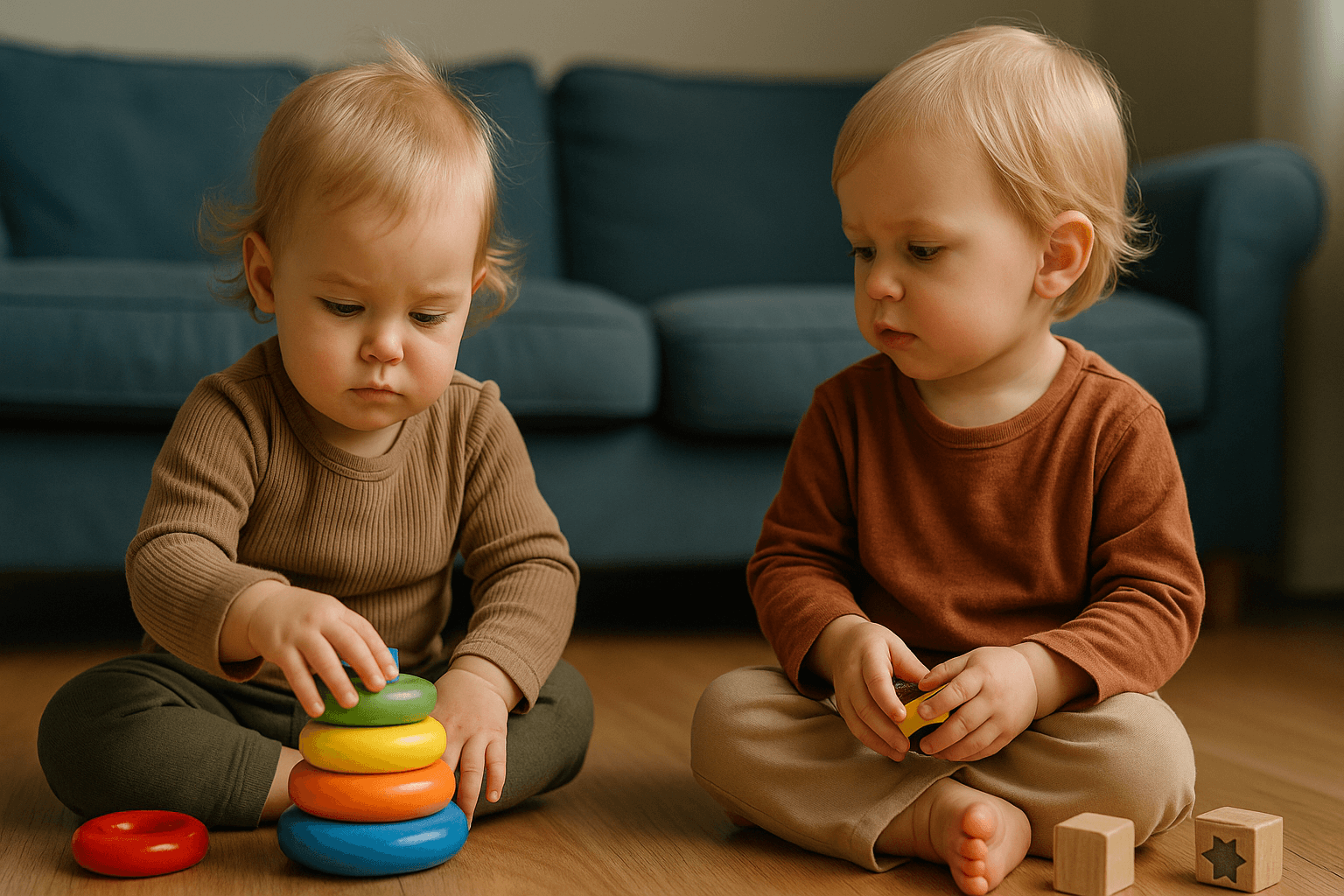
Now, children start playing next to others but without real interaction. They might have the same toys or be in the same sandbox, but they’re still doing their own thing.
Example: Two toddlers sitting side by side, each pushing their own car back and forth. They’re aware of each other, but there’s no real cooperation yet.
How to support it:
- Offer duplicate or similar toys so both children have what they need.
- Create play spaces that allow children to be near each other without forcing interaction.
- Trust that social play is on the horizon – this phase is a big step forward!
5) Associative Play (3 to 4.5 Years)
This stage is a breakthrough! Children begin to interact, talking and sharing toys, though there isn’t a shared goal. It’s more about enjoying each other’s company.
Example: Children playing in a pretend kitchen, swapping toy food or chatting about their play, but each still with their own “recipe” in mind.
How to support it:
- Encourage conversation and sharing.
- Offer dramatic play materials like dress-up clothes or play food.
- Be patient: it may look messy, but children are learning the basics of cooperation.
6) Cooperative Play (4 to 6+ Years)
Finally, children work together towards a shared goal. This is the stage where real teamwork blossoms! It usually emerges around ages 4 and up, but can happen earlier in small ways.
Example: Children building a fort together or creating a pretend restaurant where they assign roles like “chef” and “server.” Or working together to build a big puzzle.
How to support it:
- Provide opportunities for collaborative projects: large blocks, group art projects, or puppet shows.
- Guide children gently if conflicts arise: “How can we solve this together?”
- Celebrate their growing ability to work as a team.
Why Do the 6 Stages of Play Matter?
Each stage of play builds critical skills:
- ✅ Independence – in solitary and parallel play.
- ✅ Observation and learning – in onlooker play.
- ✅ Communication and sharing – in associative play.
- ✅ Cooperation and problem-solving – in cooperative play.
In Montessori philosophy, we honor each stage. We know that children develop at their own pace and that pushing a child too soon to “play with others” can actually backfire. The goal is to create an environment where children can move through these stages naturally and joyfully.
Conclusion
The next time you see your child playing alone, remember: they’re exactly where they need to be. Each stage of play is a milestone, helping them become confident, social, and capable.
Curious to have a handy reminder of these stages? I’ve created a free infographic you can download below – perfect for your home, classroom, or playroom.